By Leroy Adams
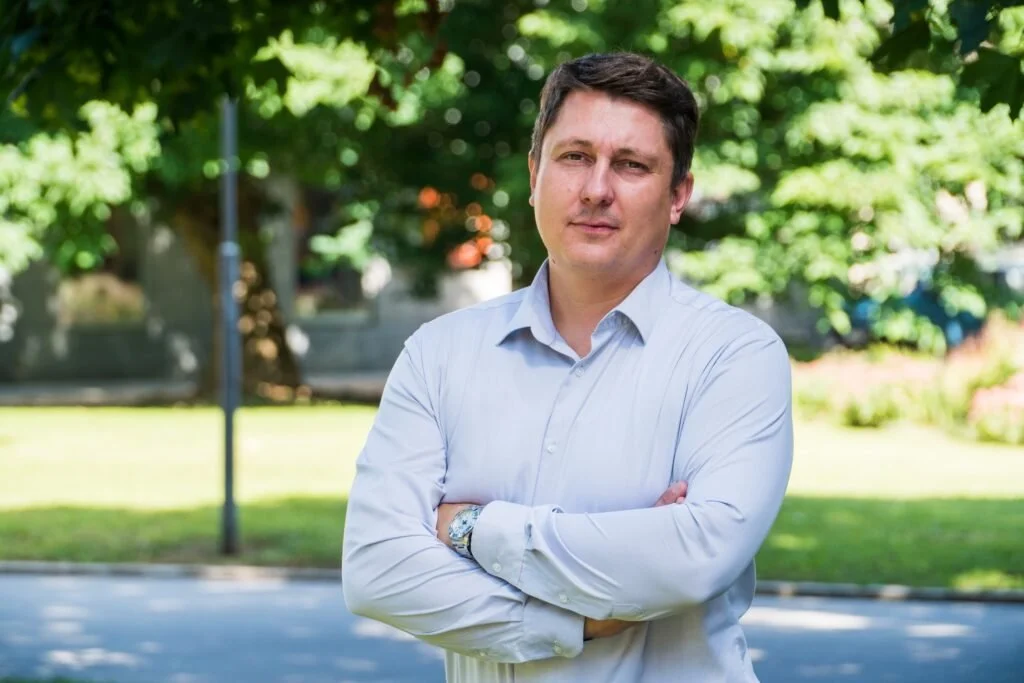
After experiencing authoritarian COVID-19 policies firsthand, electrical engineer Aleš Rezar became a citizen politician—and he has lessons for Americans navigating uncertain times.
When Aleš Rezar visited Ljubljana during the COVID-19 pandemic, the peaceful capital he knew had transformed into something unrecognizable. Protesters filled the streets. Police tensions ran high. A food delivery worker was fined for eating lunch on an outdoor staircase without a mask. For Rezar, an electrical engineer whose company faced jeopardy under what he describes as highly authoritarian policies, the breaking point had come. Along with 39 fellow citizens, he stepped into politics—not as career politicians, but as voters who decided their democracy required active participation.
Today, Rezar serves in Slovenia's parliament as part of the Svoboda party, working on legislation that has achieved record-breaking minimum wages, 3.2% unemployment, and affordable long-term care for the elderly. His journey from private sector engineer to public servant offers a compelling perspective on what it takes to preserve the calm, prosperous society that visitors to Slovenia experience—and what Americans might learn from Slovenia's approach to democratic participation, social infrastructure, and quality of life.
We spoke with Rezar about his political awakening, Slovenia's economic philosophy, and why the peacefulness travelers experience in his country must be actively cherished and fought for.
You went from electrical engineer to parliament member. What happened during COVID-19 that made you enter politics?
The atmosphere here in Slovenia during COVID was not sustainable—unpleasant to say the least. The government at that time was highly authoritarian and repressive. What people experienced was quite the opposite of the calm, peaceful Ljubljana that visitors see today. There were significant protests, high tensions between police and citizens. One example that stands out: a food delivery worker was fined for eating lunch on an outdoor staircase because the previous government's measures were so strict you couldn't be without a mask even for a short period outdoors.
The most specific thing for me was that my company—which provided really nice conditions for living in Slovenia—was jeopardized by the previous government's policies. I felt personally attacked. My current boss is now the prime minister, and with some fellow citizens, we decided to step seriously into politics. We were elected into parliament. The main thing I can say is that the calm peacefulness you experienced in Slovenia is not to be taken for granted. It must be cherished and fought for. That's the main reason we decided to step into politics.
Many Americans now consider themselves dealing with authoritarian government. What can they learn from Slovenia's experience?
I think the situation is quite global and has multiple layers. One of the most important is media coverage and the saturation of fake news. I suggest people don't take mainstream media as absolute truth. Everybody should take their part to investigate everything that's being reported so we can make reasonable judgments and decisions. That's the main problem in today's world.
Channels like yours—unbiased reviews of foreign countries and cities—are incredibly valuable nowadays because we're bombarded with news that are not actually exact or honest. The view of unbiased people is incredibly important in these days. Also, be an active citizen. Go vote. Take part in civil debates. Take part. We live in a crazy world today geopolitically, and while I believe people are in their core mostly good and honest, the power movers shift the world in ways that are unpredictable. But we people can change it.
You've helped pass significant legislation. What are you most proud of accomplishing?
The most important achievement is the long-term care for the elderly, which is now paid by only the minimum pension for elderly people in care homes—approximately half cheaper than before. We have record-breaking minimum wage, record-breaking average wage, and inflation is quite sustainable at 3.1%. We have a record-breaking unemployment rate of 3.2%, which is remarkable. Record-breaking pensions in this mandate. And reforms of healthcare legislation.
We have free healthcare and free education, which is wonderful. That's probably the positive cause for why we have highly educated people in Slovenia and highly tech-oriented companies. When you take into consideration that your parents or grandparents can be in healthcare centers practically for free, that you have free education and free healthcare—I believe it's worth paying a bit more in taxes to have all these opportunities.
Americans often hear "but the taxes are so high" when discussing European social programs. How do Slovenians view this trade-off?
The most important thing for me is the net income rate and quality and cost of living here, which is quite sustainable even with average wage in Slovenia. The ratio between gross wage and net wage is quite large, but you have all these considerations built in. Everybody—or at least the opposition—complains about taxes when they're in opposition. But taxes in Slovenia are not all that high. It's other contributors that bring the ratio up, but that didn't change from ten years ago.
Here's what's important: you don't have to pay the amount that was missing previously for your parents or grandparents who have small pensions. If you look at well-developed countries, none of them have low taxes. Only tax islands have small taxes, and the quality of living there is not something to be proud of. In Slovenia, when you consider the income sustainability and what you receive—free healthcare, free education, affordable elder care—it's a wonderful thing.
What investment opportunities does Slovenia offer for entrepreneurs and foreigners?
In our core, we are hardworking, proud of our work and country. Due to being a highly qualified and educated nation, we are most competitive in research and development. We mostly have really high-tech companies—some of them are worldwide the best you can find. The sectors today are pharmaceutical, laser technology, satellite technology. We have probably the best company for measurements and diagnostics, which is known in America really well.
Investors sense and see that we're reliable, and we're attracted to the biggest investments. Practically this year or the previous year, we had record-breaking investment in the pharmaceutical sector—multiple hundred millions for one company, which will probably exceed a billion over the coming years. What makes Slovenia attractive is that we have stable and predictable terms about trade. That's probably the most important—predictability. We're known as reliable, hardworking, highly skilled, and research-oriented.
Slovenia only derives about 5% of GDP from tourism. How do Slovenians think about visitors?
Tourism is not on our high list of priorities or agenda to attract the most tourists. We are a really welcoming nation—we're glad tourists come—but that is not our highest agenda. We're mostly economically and export-oriented. Economics makes a firmer, more stable country than tourism alone. It's also not seasonal like tourism is.
Perhaps you've been to Split in Croatia. There's already a too-crowded situation where tourists can't even see the landscape properly because of over-crowding. We prefer a balanced approach. We're inviting and welcoming to everybody who comes, but our economic stability comes from our export industries and high-tech sectors.
If I'm visiting Slovenia for the first time, what should I see?
Of course Ljubljana—as the mayor said, "the most beautiful city in the world." Then I would suggest Gorenjska region: Bled, Bohinj, the mountains. Wonderful landscape. The downside is it gets quickly overcrowded because the infrastructure is so narrow with the roads. Also Logarska dolina in Savinjska—another stunning valley. The list could go on and on. For such a small country, we really offer a lot in terms of landscape and diversity.
I believe we have the most biodiverse landscape in Europe, especially for such a small area, because we have high mountains, some flat spots, and also the sea. The mix of the Alps and Mediterranean is really diverse and beautiful. When I went to other big cities around the world, I always loved coming back to Slovenia. I haven't found a place yet where I'd say "I could move there." It's the quality of living, culture, warm people, and good conditions for work.
How would you describe Slovenian cultural identity?
We are peaceful, hardworking, proud. We're open to meeting new people and open to everybody who wants to interact with us. We're a warm-welcoming nation. Slovenians are warm-hearted at the core, at least mostly. We cherish privacy in our homes—probably why most Slovenes have practically their own real estate—but when walking on the street, if you approached me, I would be with open arms discussing with you. We have quite a lot of visits. We're glad to spend time with friends and family. We're not so closed off.
What excites you about Slovenia's future?
I just want to maintain it like this—at least that, or make it better. What excites me is cooperating to make laws that make living in Slovenia easier. When we decided to go into politics, the main hurt was the injustice that happens throughout multiple areas. I want to bring equal justice for everybody, deserving payment for everybody, to bring the most paid and the least paid closer together so society can be more uniform.
You don't want to live in a country where some percentage of people are without heating, without food, without essential needs to live well, and others don't even have an idea how to spend it all. That's a global phenomenon nowadays—a small amount of people hold 99% of all wealth. Here in Slovenia, I believe we have quite a good ratio of that, and in my personal opinion, I want to bring that even closer.
For travel planning resources, visit Slovenia's official tourism portal at slovenia.info.