By Leroy Adams (and, as of this trip, Kofi Owusu)
Culture Travels Magazine
There's no way to tell this story justice in one sitting. So we won't try.
This is Part One of a three-part series chronicling the Tubman Project's inaugural service-learning capstone to Ghana — a journey that took three Black educators from Chicago across the Atlantic in search of purpose, belonging, and, as it turned out, themselves. This issue is the why — the beginning, and who we were before we ever arrived. Part Two will carry you through the National Educators Conference, and the dungeons of Cape Coast and Elmina Castle, ending at the Door of No Return. Part Three closes the journey: the naming ceremony that gave our production team ancestral names of our own, the classrooms of Akropong, a moment fifty feet above the forest floor, and the long way home across the Atlantic.
But every homecoming has a beginning. This is ours — the why, told first through the woman who built it, and then through the three educators who agreed to carry it.
The Woman Behind The Vision
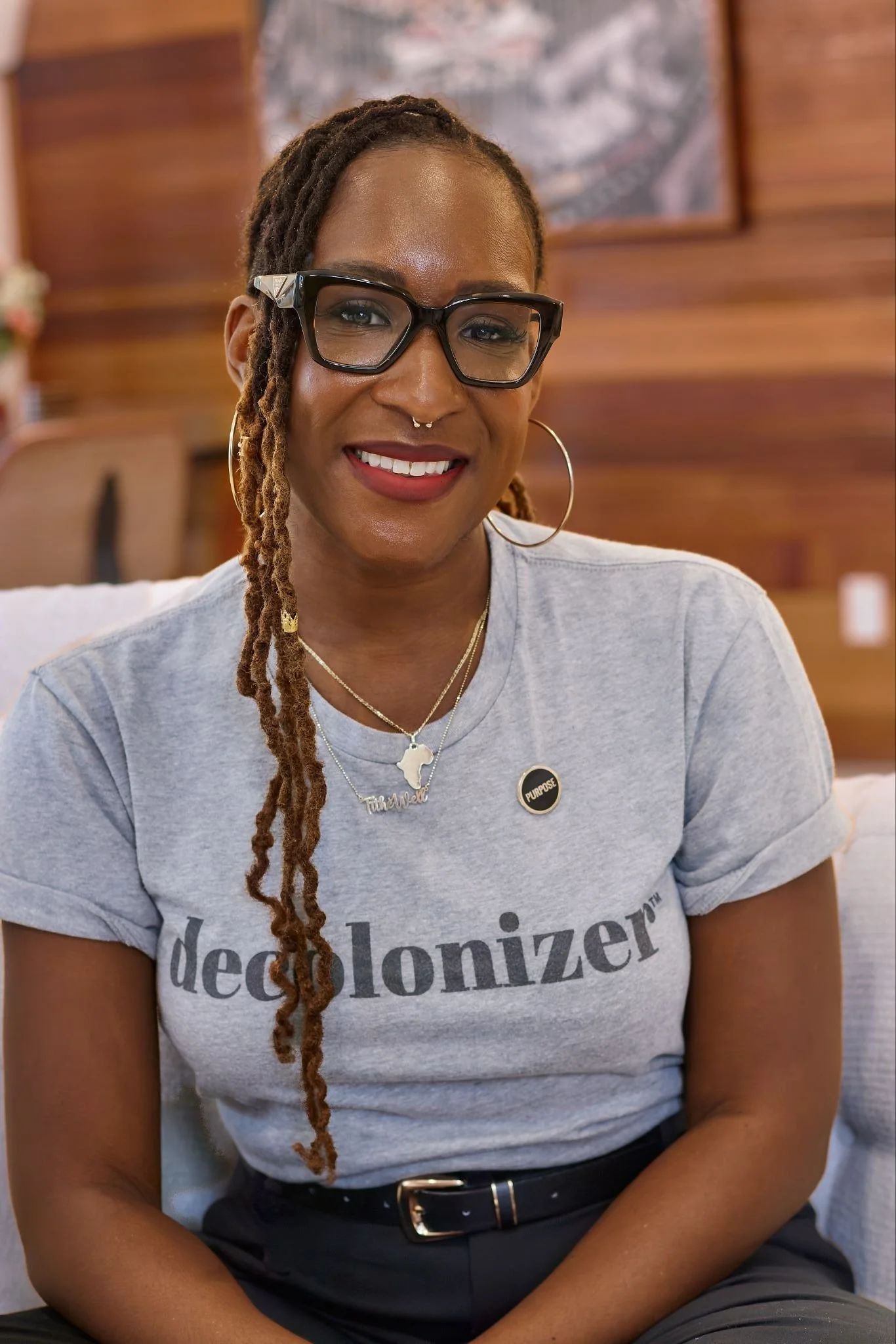
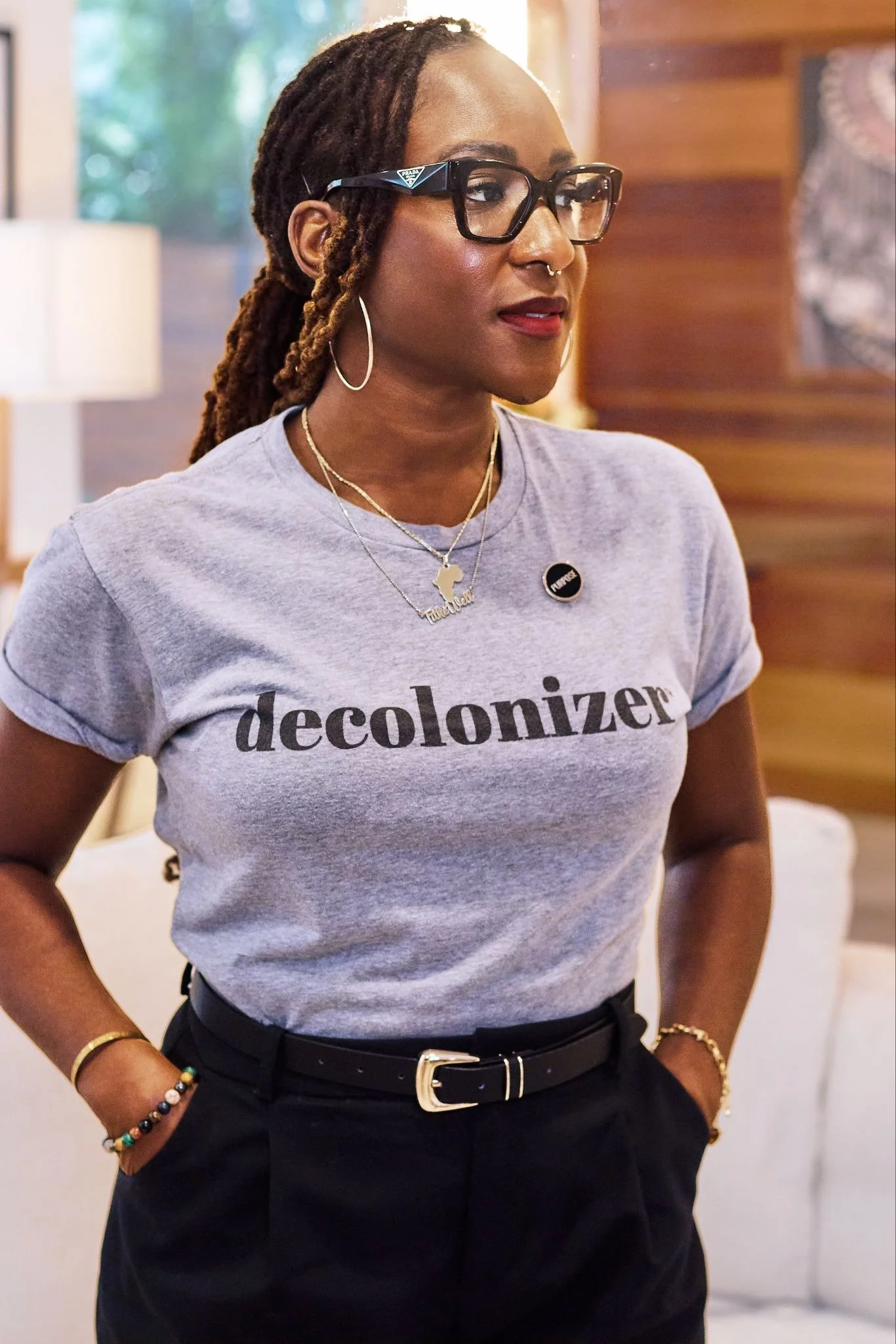
Before we ever landed in Accra, we sat down with Nye in her home in the States — surrounded by African art, soft light, gold jewelry, her braids draped across her shoulders — to understand the why behind all of this.
For over a decade, Nye Trusty's work as a teacher, leadership development coach, and facilitator has helped shape student, teacher, and school outcomes in communities across Maryland, D.C., Georgia, Louisiana, Texas, El Salvador, Mexico, and Brazil. As a certified Yoga Instructor (CYT-200) and Holistic Life Coach, she blends classroom experience, liberatory consciousness, and embodied wellness to help schools retain their best educators and sustain student achievement.
The Tithe Well, created by Nye, is an education-based wellness organization built to retain top educational talent by making the career of teaching more sustainable. The Well operates as a multi-tiered support system:
Tier 1 offers districtwide, on-demand and live professional development that embeds wellness into existing support systems, giving educators tools to manage stress and prevent burnout before it becomes turnover.
Tier 2 is strategic retention advising — district partnerships that design and strengthen adult support systems to address the root causes of teacher turnover.
Tier 3 — where the Tubman Project lives — is targeted 1:1 and team coaching and retreats that help educators rebuild their inner capacity, reconnect with their purpose, and reclaim the sense of belonging and community that sustains their work.
The Tubman Project itself was born on a beach.
Nye had visited Ghana once before, in 2021. In 2023, she returned with her mother, carrying three questions for her ancestors:
Where should I be putting my energy right now?
How do I use my gifts to make an impact?
What is that impact supposed to look and feel like?
She was sitting on Labadi Beach, doing yoga, journaling — not actively asking the questions, but holding them. And then, in her words, it felt like someone tapped her on the shoulder and invited her into conversation.
"Typically, when spirit talks to me, it's through questions," she told us."What would it look like to bring other people here?"
She'd already brought her mother. Could she bring others? What kind of others? She works with educators — what would it look like to bring educators? What would it look like if they all came from the same place, so they could build something together, not just individually? What would it mean to turn one visit into a fellowship? And most importantly, how would they take what they experienced in Ghana and bring it home?
The skeleton of the Tubman Project came together on that beach. Nye journaled the ideas, built them into an action plan, and came home — in her words — "so hyped." What started as a scaffold of questions has since bloomed into something living, something with organs of its own.
Chicago Send-Off
Before any of us set foot in Ghana, we sat down in Chicago with the three Fellows chosen for this inaugural cohort — Principal Rashad Talley, Athletic Director JD, and Director of Instruction Kristen Zaki — to ask them what they were hoping to find, and what they were hoping to leave behind.
Principal Rashad Talley is nearing 50, and describes this trip as the answer to a lifelong desire to put his feet on the motherland. Weeks before departure, he visited his father's gravesite for the first time in nearly 30 years — his father passed away when Talley was just 15 — and realized, in that moment, he'd been carrying thirty years of ungrieved loss without fully naming it as grief. "I want to close out that grief," he told us. "I want to be whole. I want to be at 100% of everything — the best father, the best husband, the best principal." He frames the trip through the wider lens of ancestry, too — the Great Migration, the family history he carries as an educator, and the responsibility he feels to pass that knowledge down to his own children and to the younger generation in his family.
Asked what he hopes his students take away from watching him go through this experience, Talley pointed to something bigger than the trip itself: the willingness to open yourself to a new perspective. "But I do expect my perspective to be different," he said, "and I want to make that as contagious as possible." And when asked how this trip might change the way he leads his school, he was quick to note that urgency and purpose are already how he operates — "I lead with urgency already. I lead with purpose." What he's after isn't a new leadership style, but a wider lens to lead through.
JD, Wendell Phillips' Athletic Director, lost his mother five years ago to breast cancer. He's carrying that loss into his mid-thirties, still working through what he described as the number one thing on his heart: purpose. He didn't talk with his mother directly about legacy — he watched her build one, in how she showed up for her community and lived out her own purpose every day, even while she fought for her life. That's what he wants to carry forward: to fully live, to fully learn his own purpose, so that when God calls him home, he can hear "well done, my good and faithful servant.""I want to be the voice for the people that's not able to leave," JD told us, describing a trip that is as much about honoring her as it is about discovering himself. He connects the idea of ancestry directly back to her — wanting to trace his family's roots, to know who came before him, so he can pass that knowledge down to his own children and community. And he hopes this trip does more than change him. He wants his students to be inspired to go out and see the world for themselves, to seek out new experiences beyond what's familiar.
Kristen Zaki, Director of Instruction, brings a different thread into the cohort — Egyptian by heritage, and genuinely curious about how her own identity intersects with the wider African diaspora she'll be stepping into. A doctoral candidate at USC, Zaki told us that a class on critical pedagogy recently surfaced grief she hadn't realized she was still carrying: over fifteen years at Phillips, she has lost eleven students to community violence. She keeps their names in her journal. She keeps their names on the altar at her church. "I think a lot of what this project has taught me," she said, visibly emotional, "is how important it is to look inward before going on outward — to deal with what you carry before trying to help others deal with what they're carrying." Beyond that grief, Zaki returns again and again to a single idea: that opening yourself to other cultures, other beliefs, other ways of life makes you a better human being. It's the lens she hopes to bring back to her students through this trip: that the willingness to sit with someone else's way of seeing the world isn't a threat to your own, but a gift that serves you for the rest of your life.
Three different educators. Three different kinds of motivations and loss. All of it walking with them into Ghana, whether they'd fully named it yet or not.
Arrival
We picked the Fellows up from the airport on a Friday morning, and whatever fatigue usually follows a 16-hour flight over the Atlantic was nowhere to be found — replaced instead by wide eyes and disbelief at a version of Accra none of them expected: alive, chaotic, thriving. That night, an unplanned dinner at ZEN Garden turned into an unexpected reunion, as the Fellows found themselves seated among other Black American educators also in Ghana, coincidentally, for a national conference happening the same week. JD said something over dinner that would echo through the rest of the trip: "The way they described Africa to us back home is not the Africa I'm looking at right now."
JD was fascinating to observe during the trip. He's 6'8", a former pro football player built like the athletes he now coaches — a gentle giant who, in America, is feared simply for existing. The morning after dinner, over breakfast, he told Nye he'd already found his purpose. He hadn't. Not yet. What he'd found, sitting at that table less than 48 hours into the trip, was space. Clarity. Permission he'd never given himself back home to simply think about himself — his dreams, his passions, his purpose. The real answer was still waiting for him, a few days ahead, on sacred ground he hadn't walked yet.
What's Ahead
On Day Four, the Fellows made their way to Cape Coast and Elmina Castle — the dungeons where captured Africans were held before being marched through the Door of No Return and onto ships bound for the Americas.
We won't take you inside those walls yet. What happened there — for Talley and his thirty years of grief, for JD and the mother he's still learning to let go of, for Zaki and the eleven names she carries in her journal — deserves its own telling, its own space, in Part Two.
For now, we wanted you to have the foundation: the why, carried by the woman who built this, and the who, carried by three educators who left Chicago holding more than they'd said out loud. Within 48 hours of landing in Accra, they had already started to, in the words of Frederick Douglass while visiting Ireland, "live a new life."
To be continued.